In this briefing
- 01A commercial deskside option exists, but its capacity figures lack full operating conditions
- 02The self-hosted location puts storage, security baselines and recovery mechanisms in one version
- 03The embedded location remains between live demonstration and planned deployment
- 04Three locations mean three product states and three evidence sets
- →What to watch next
- ↗Sources and verification
- On 24 September, Dell again described Deskside Agentic AI, which it had announced as available in May (month 5). Its model-scale and concurrent-Agent ceilings are vendor capacity claims; the public material does not provide full operating conditions, whole-system power, a fixed solution price or independent performance results.
- Intel AI for Enterprise Solutions v1.1.0 brings RAG, enterprise storage, security baselines and optional backup into one installation entry point. It states which mechanisms the software Release contains; it does not mean that performance, recovery or production reliability has been accepted in the target environment.
- SoundHound announced the OASYS Edge embedded voice-Agent architecture, with live demonstrations available now and deployment planned for late 2026. The chip, memory, model specification, power, latency, throughput, price and volume-production customer remain undisclosed.
A commercial deskside option exists, but its capacity figures lack full operating conditions
On 24 September, Dell published an official guide to running Agents locally and again described Dell Deskside Agentic AI. The combination covers Dell Pro Max with GB10, Dell Pro Precision T2, T4 and T6 Tower, and Dell Pro Max with GB300, while placing NVIDIA NemoClaw, OpenClaw, OpenShell, NVIDIA Agent Toolkit, Nemotron models and Dell Services within one solution. This was not a product first launched that day: Dell's announcement of 18 May had already marked Deskside Agentic AI as available now.
The guide of 24 September groups GB10 and T2 as the entry tier and gives a vendor ceiling of a 200 billion-parameter model and 8 concurrent Agents for that tier; T4 corresponds to up to 500 billion parameters and 40 Agents; the GB300 and T6 combination corresponds to up to 1 trillion parameters and 150 Agents. The page does not specify the particular model, quantisation, context, batch, definition of concurrency, time to first Token or throughput, nor does it give whole-system dimensions, power, noise, a fixed solution price, regional stock or delivery time.
For enterprise deployment, a deskside solution places hardware, the Agent runtime stack and services inside one procurement boundary, which can be assessed alongside situations where data cannot leave a workgroup, the network is unreliable or a capital budget is required. Model parameter scale and concurrent-Agent counts cannot be converted directly into the completion speed, correctness or availability of a business task; the target model, quantisation, context, tool calls and human-review conditions still need separate validation on the same configuration.
The self-hosted location puts storage, security baselines and recovery mechanisms in one version
On the same day, Intel released Intel AI for Enterprise Solutions v1.1.0 on GitHub. The Release brings Intel AI for Enterprise RAG 3.0.0 into the unified installation entry point and pins its inference dependency; it also adds the option to use NetApp ONTAP through Trident CSI, alongside local-path, NFS and Ceph. The installer also enables Pod Security Standards by default and applies restricted or baseline according to what each namespace can support, rather than labelling every workload at the highest level.
The version also provides an optional Velero component and a profile-based backup and restore engine, but velero_enabled defaults to false, each solution must still provide its own backup_profile.yaml, and the repository itself ships no universal backup action. The Release also fixes multi-node inventories that did not explicitly use SSH. The public description lists mechanisms and fixes, but provides no performance test for third-party storage, recovery-time objective, failure-drill result or independent reliability data under production load.
For enterprise deployment, acceptance of a self-hosted platform covers more than whether a model starts: it also includes storage classes, namespace policies, identity components, backup scope, recovery order and multi-node connections. The Release lists these mechanisms and their defaults; it does not prove that a target cluster is a recoverable production system. Deployment records, backup profiles, recovery exercises and capacity tests remain different forms of evidence.
The embedded location remains between live demonstration and planned deployment
At 09:02 US Eastern Time on 24 September, SoundHound announced OASYS Edge for vehicles and smart devices, placing voice-Agent intent interpretation, device-state reading and multi-Agent orchestration at the endpoint. The official material says that manufacturers and service providers can build once on OASYS, then deploy by task to edge, cloud or hybrid environments; requests that can be completed locally remain on the device, while steps needing online information or services call the cloud.
The product status has a clear boundary: SoundHound says that live demonstrations are available now, deployment is planned for late 2026, and it will be shown at CES 2027. This is not evidence of delivery at scale or of a product in volume production and on sale. Neither official item discloses the target chip, CPU/GPU/NPU configuration, memory capacity and bandwidth, model parameters and quantisation, context, language coverage, whole-system power and dimensions, time to first Token, throughput, concurrency, price, OEM customer, certification or after-sales operating conditions; fast response, low-cost chips and privacy benefits also remain vendor statements.
For enterprise deployment, the value of an embedded Agent is that part of the data-processing and control chain can stay inside the device and combine with cloud services when needed. It also brings functional safety, the device lifecycle, offline updates, resource ceilings and field support into the AI-system boundary. A current demonstration can validate an interaction direction, but it cannot replace validation of production hardware, target-region regulation, disconnected conditions and end-to-end failure modes.
Three locations mean three product states and three evidence sets
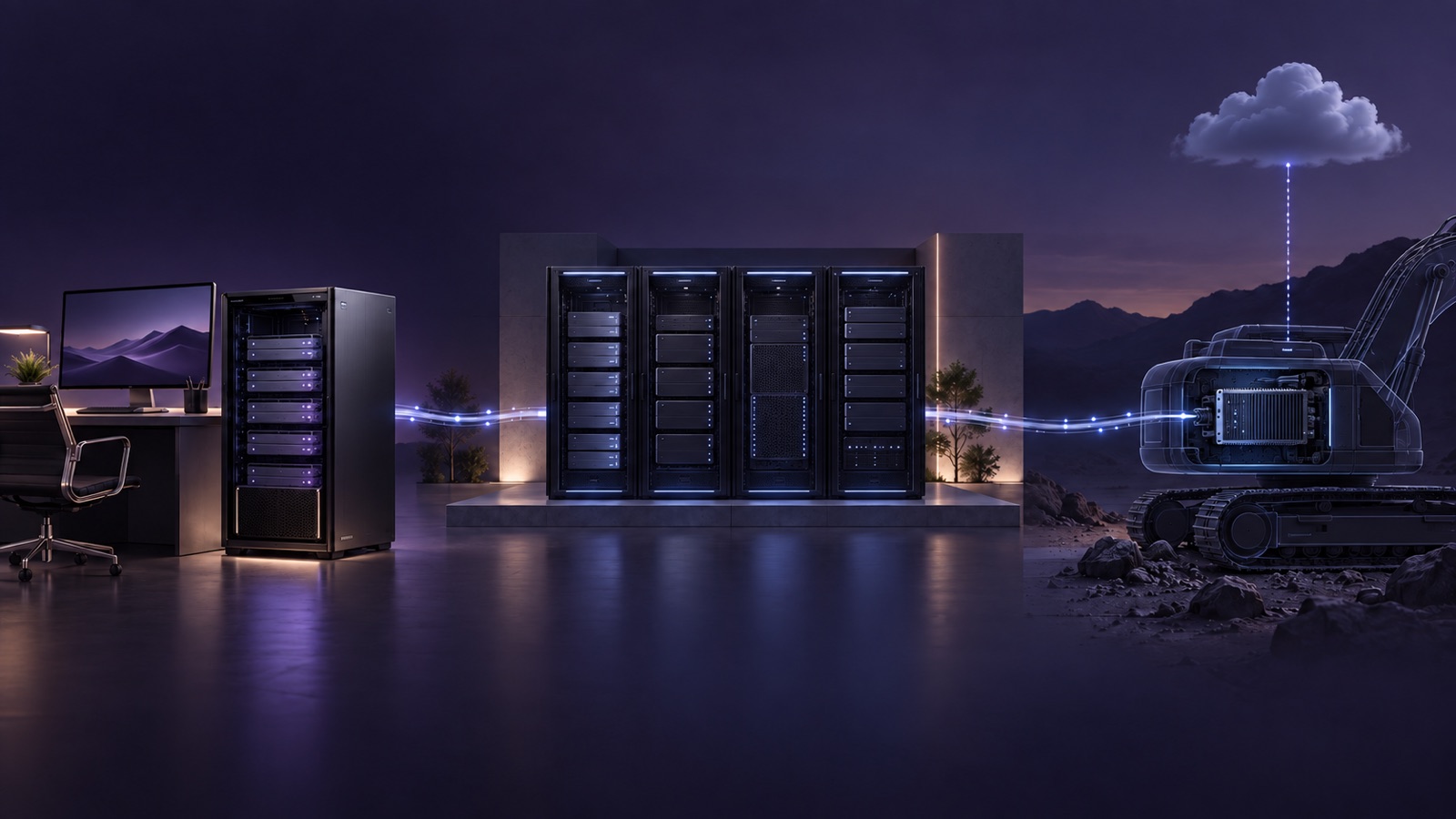
Dell's material describes a commercial solution already announced as available, Intel provides a software Release that can be reviewed and deployed, and SoundHound presents an embedded architecture that can be demonstrated and is planned for deployment late in the year. All three place models or Agents closer to data and the point of business execution, but their procurement states, control boundaries and operating responsibilities differ: deskside systems centre on single-system configuration and workgroup support; self-hosted platforms centre on cluster components and recovery processes; embedded devices also face endpoint resources, connectivity conditions and long-term maintenance.
The public material does not form a continuous, comparable dataset for volume, power, memory, performance, price and supply. It therefore cannot support a conclusion that enterprise-model deployment has completed a uniform migration from data centres to smaller devices, nor can the three updates be treated as a validated hardware-miniaturisation trend. What they jointly show is an increase in the deployment locations proposed by vendors; whether each location works still depends on quality, latency, throughput, concurrency, failure recovery, data flows, total cost and purchasing status for the same business task.
For enterprise deployment, the location and the evidence type need to be recorded together. Commercial availability, open-source installability and a live demonstration respectively answer 'can it be bought?', 'what does the code contain?' and 'can the interaction be shown?', but each cannot alone answer whether the target business can run reliably. Keeping status separate from measurement conditions helps avoid substituting parameter ceilings for performance, a Release for operating validation, or a prototype demonstration for a volume-production commitment.
What to watch next
- Whether Dell will publish time to first Token, throughput, power, fixed-configuration prices and regional delivery information for particular systems, models, quantisation, context and concurrency definitions.
- Whether Intel AI for Enterprise Solutions will publish recovery exercises, compatibility matrices and performance boundaries for NetApp storage, Pod Security Standards and Velero profile use in real multi-node environments.
- Whether SoundHound will disclose the target chip, memory, model specification, offline capability, functional-safety certification, OEM customer and volume-supply conditions for OASYS Edge before its planned deployment in late 2026.
Sources and verification
Golden Data has edited this briefing from the public materials listed above. The original sources govern facts and figures. The enterprise relevance sections are Golden Data editorial analysis and do not constitute an endorsement of any third-party product.
← Back to AI Daily Briefing