In this briefing
- 01Dell Technologies Makes Data Context a Traceable Reusable Asset
- 02GitHub Brings Agent Customisation Sources Under Enterprise Policy
- 03Baseten Connects Training Results to Model Adapters and Deployment Endpoints
- 04Reuse Governance Also Covers Model and Runtime Replacement
- →What to watch next
- ↗Sources and verification
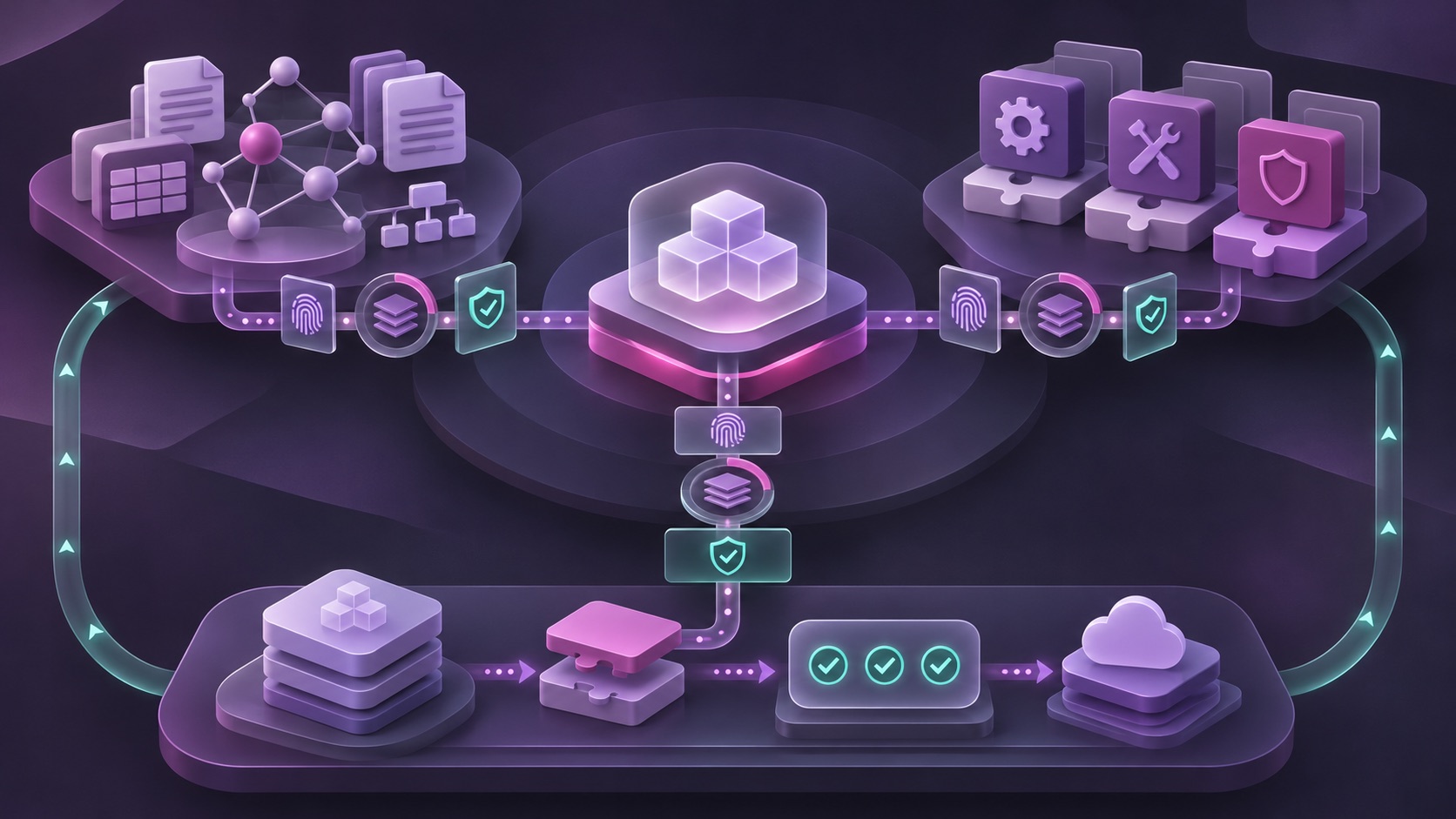
- Dell Technologies says its Agentic Data Gateway connects approved models, data and Model Context Protocol tools within a customer environment, while the gateway records each call against the caller's identity, data scope and budget.
- GitHub now lets enterprise administrators restrict the sources of skills, custom Agents, hooks, Model Context Protocol servers and executable extensions, but its plugin-source restriction does not replace a marketplace-source allowlist.
- Baseten has made Serverless Loops generally available, and the product connects supervised fine-tuning, reinforcement learning, checkpoint evaluation, model adapters and dedicated inference deployment.
Dell Technologies Makes Data Context a Traceable Reusable Asset
Dell Technologies announced new data-orchestration capabilities for the Dell AI Data Platform on 16 November. Agentic Data Gateway provides OpenAI compatible endpoints and Model Context Protocol endpoints within a customer environment, and the gateway places approved models, data, search, structured queries and external services within a common registry. Dell Technologies says each call uses the caller's identity, data scope and budget, while the platform centrally manages credentials, quotas, token accounting and end-to-end tracing.
Dell Technologies also announced Storage Intelligence and Data Intelligence. Storage Intelligence creates a file-metadata catalogue, while Data Intelligence records provenance, data quality, observability, tables, datasets, vector indexes and business glossaries. Dell Technologies reported up to a 76% reduction in total token consumption and an increase in answer accuracy from 60% to 94% on an internal synthetic toll-plaza operations dataset. The test covered only 20 questions and 6 workload types, so the result is a vendor-run internal test. The verified blog does not give one generally available date for all the new data-orchestration capabilities.
For enterprise implementation, an organisation needs to treat reusable context as a data asset with provenance, an owner, a version, permissions and an expiry date. A unified gateway can reduce the work required when each Agent would otherwise store credentials and rebuild retrieval logic, but an organisation still needs to verify which data version, business definition and permission scope the gateway actually used. Results from a vendor's synthetic data cannot replace acceptance testing on the organisation's own data, concurrency, erroneous-context and access-control conditions.
GitHub Brings Agent Customisation Sources Under Enterprise Policy
GitHub added the `strictPluginOnlyCustomization` enterprise-managed setting on 16 November. Enterprise administrators can use the setting to block standalone customisations from users and projects, and they can apply the restriction to five classes of object: skills, custom Agents, hooks, Model Context Protocol servers and executable GitHub Copilot extensions. Plugins and enterprise-managed settings that satisfy other policies can still provide those customisations.
GitHub explicitly states that allowing only plugins does not mean that an enterprise has restricted plugin-marketplace sources. An enterprise that needs to restrict marketplace sources must also use `strictKnownMarketplaces` and its existing plugin policies. The capability applies to GitHub Enterprise Cloud, and affected members need GitHub Copilot Business or GitHub Copilot Enterprise licences issued by the enterprise or by an organisation within the enterprise.
For enterprise implementation, an organisation cannot inspect only what a skill or tool can do today. The organisation also needs to record which marketplace, plugin, version and approval process supplied the customisation, and the organisation needs to distinguish personal, project and enterprise-managed configurations. Source restrictions can reduce the probability that an unapproved tool enters a production workflow, but source restrictions cannot automatically validate plugin code, updates, runtime permissions or the data-handling practices of external services.
Baseten Connects Training Results to Model Adapters and Deployment Endpoints
Baseten updated its Serverless Loops announcement on 16 November, and Baseten marked Serverless Loops as generally available. The training software development kit supports supervised fine-tuning and reinforcement learning, while the initial release provides training contexts of up to 256,000 tokens for selected open-weight models. Customers can submit datasets or connect reward functions, evaluate training checkpoints and deploy training results to Baseten Dedicated Inference.
Baseten says the platform loads a model adapter with its base model at an inference endpoint, and customers can also download weights in the Hugging Face Safetensors format. Baseten also says the generally available release improves handling for transient network errors and graphics-processing-unit failures, reduces startup overhead and accelerates weight transfers between trainers and samplers. Baseten's published customer results, request volumes and runtime performance all come from vendor material, and the public material does not provide an independent cross-platform reproduction.
For enterprise implementation, an organisation needs to bind training data, reward functions, base models, model adapters, evaluation sets, checkpoints and deployment endpoints to one version record. A platform can shorten the path from training to deployment, but the platform cannot prove for an organisation that an adapter preserves the same result on a new base model, a different inference runtime or different hardware. Downloadable weights provide a migration route, but downloadable weights do not automatically guarantee that service behaviour, performance and failure recovery remain fully portable.
Reuse Governance Also Covers Model and Runtime Replacement
GitHub deprecated Claude Opus 4.8, Claude Opus 5 and GPT-5.6 Terra across most GitHub Copilot experiences on 16 November, and GitHub listed suggested replacement models for all three models. Existing enterprise model policies remain in effect. If enterprise administrators have disabled the global default policy, those administrators need to enable replacement models separately in GitHub Copilot settings. An existing workflow can require renewed validation when model availability changes even if an organisation does not change the workflow's customisation content.
GitHub announced on the same day that Visual Studio Code 1.146 had deprecated the Local harness that coordinates models, context and tools, and GitHub plans to remove the runtime in February 2027, which is month 2 of that year. Replacement software does not automatically move local files to the cloud, but choosing replacement software does not automatically enable a sandbox. GitHub also states that switching runtimes does not automatically convert every customisation, so enterprise administrators need to verify workflows, permission controls, sandbox configuration and customisation compatibility separately.
For enterprise implementation, an organisation needs to accept reusable assets together with the actual model, runtime, permission policy and sandbox settings. If an organisation stores only the content of a skill, prompt, dataset or model adapter, the organisation still cannot prove that the asset behaves in the same way after a platform replacement. An organisation needs to retain compatibility tests, evaluation results, permission differences, rollback conditions and comparisons of business outcomes for each model or runtime migration.
What to watch next
- Dell Technologies may clarify the availability status, versioned interfaces and exportable provenance formats for all its new data-orchestration capabilities.
- GitHub may provide more complete policy-conflict diagnostics and migration tools that help enterprises verify plugin sources, marketplace sources, model policies and runtime compatibility together.
- Baseten may publish more information about models, pricing, service levels and cross-platform reproduction conditions, while independent testing may assess differences between downloaded weights and hosted endpoints.
Sources and verification
Golden Data has edited this briefing from the public materials listed above. The original sources govern facts and figures. The enterprise relevance sections are Golden Data editorial analysis and do not constitute an endorsement of any third-party product.
← Back to AI Daily Briefing