In this briefing
- 01The Transparency Initiative Separates Three Sources of Evidence
- 02A Cross-Platform Control Plane Starts to Combine Owners, Risk and Cost
- 03Clients and Infrastructure Begin to Provide Runtime Records at Different Granularities
- 04Operational Cyber Defence Keeps Oversight and Economics in the Evidence Chain
- →What to watch next
- ↗Sources and verification
- Microsoft is working with more than 40 organisations on approaches to artificial-intelligence transparency across models and providers. Microsoft states explicitly that enterprises need to distinguish evidence produced by model self-reporting, runtime records and independent identity or policy systems. The initiative remains at the stage of building standards and incorporating them into products.
- Microsoft Agent 365 is expanding registration for non-Microsoft Agents, dynamic risk, multi-tenant management and cost analysis. GitHub now lets eligible enterprise customers send prompts, responses and tool calls from several GitHub Copilot clients into the platform. Several capabilities remain subject to preview status or licence boundaries.
- Anyscale turns the six stages before training data reaches a graphics processor into runtime metrics. OpenAI's published account of NATO cyber-defence work retains human oversight, task evaluation and an assessment of usage economics. Enterprises need to accept this independent evidence together with model output.
The Transparency Initiative Separates Three Sources of Evidence
Microsoft announced the AI Transparency Initiative on 17 November. Microsoft says that the company is working with more than 40 organisations on approaches to transparency, safety and governance across models and providers. Microsoft also plans to connect the work to the United States National Institute of Standards and Technology initiative on Agent standards. Microsoft describes the objectives as seeing what artificial intelligence accesses and executes, verifying artificial-intelligence actions independently and controlling the scope of actions that artificial intelligence may perform.
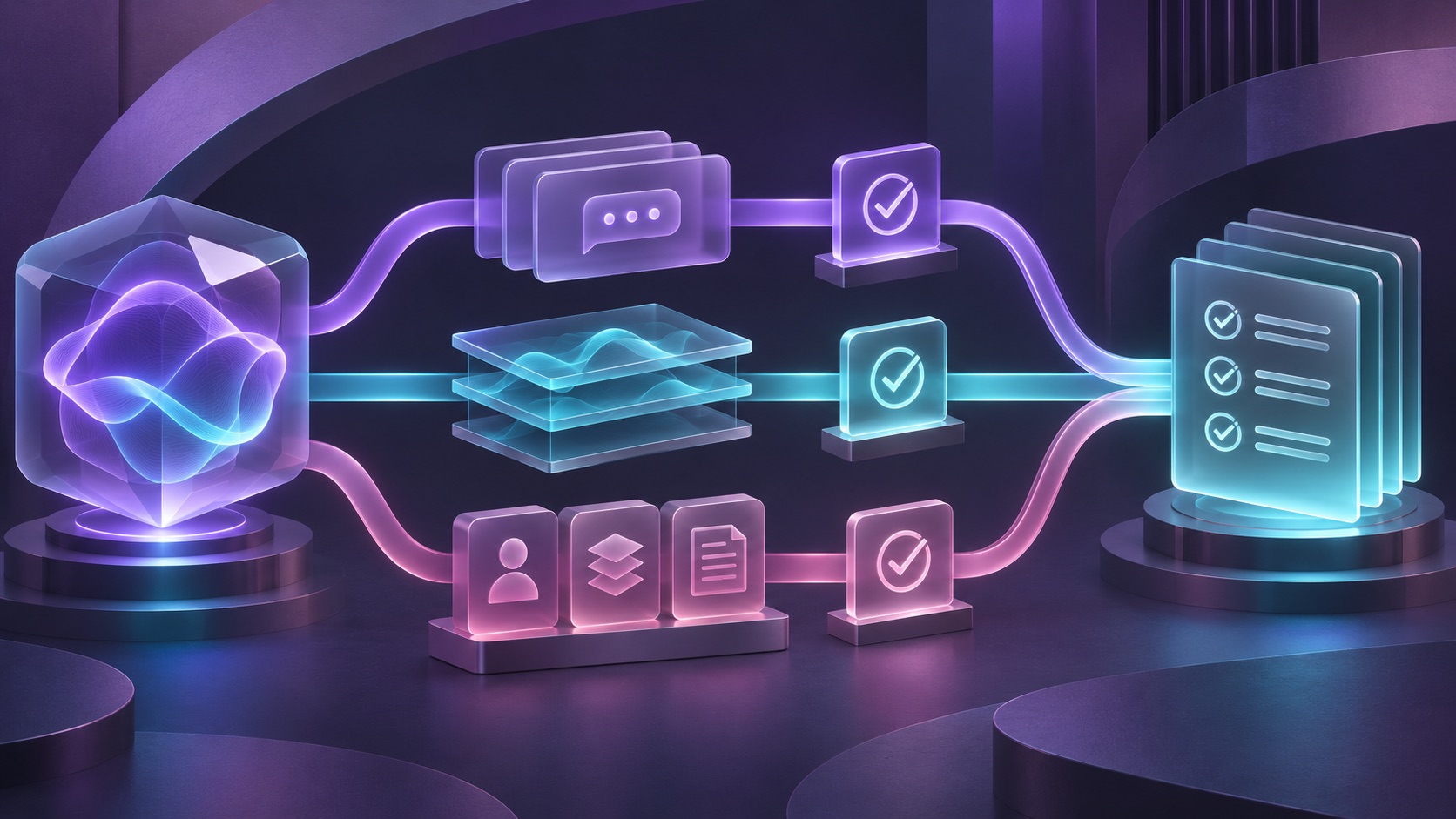
Microsoft further requires each item of evidence to identify its own source. A model can report its own behaviour, a runtime can record tools and execution outside the model, and independent systems such as identity and policy systems can provide another source for verification. Microsoft also states explicitly that an Agent cannot be the sole source of truth about its own behaviour. The initiative that the National Institute of Standards and Technology announced in February, which is month 2 of the year, covers industry standards, open protocols and research into Agent security and identity. The Institute nevertheless listed further research, guidance and deliverables as future work.
For enterprise adoption, an enterprise cannot treat an explanation generated by a model as a complete audit record. The enterprise needs to preserve the source type, time, version and related identifier for every identity, delegation, input, tool call, policy decision and business result. The enterprise also needs to use the runtime or an independent system to check the model's self-report. The Microsoft initiative provides an emerging direction, but the initiative has not yet produced one completed common standard. Enterprises still need to implement specific controls under existing regulation and internal policies.
A Cross-Platform Control Plane Starts to Combine Owners, Risk and Cost
Microsoft announced Microsoft Agent 365 updates on the same day. Microsoft says that, since the platform launched in May, which is month 5 of 2026, organisations have registered more than 50 million Agents in it. The platform is bringing Agents from Microsoft platforms, partner platforms and employee devices into one view. Supported platforms can provide the creation location, owner, tools, activity, model calls and task results for an Agent.
Microsoft also retains different maturity and licence boundaries. Microsoft Entra Agent ID for more partners, dynamic Agent risk and multi-tenant management remain in Preview or Public Preview. Agent 365 Business Analytics remains in Frontier preview. Basic usage and activity metrics for some Microsoft Agents are generally available, but insights for non-Microsoft Agents and advanced governance capabilities still require an Agent 365 or ME7 licence. Specific capabilities may also differ between platforms.
For enterprise adoption, a unified control plane can help information-technology, security and business teams use the same Agent inventory, but one unified page cannot automatically guarantee that the underlying evidence is complete. An enterprise needs to check which fields each source platform supplies, how often each field updates, how the system displays connection failures, which actions an administrator can perform and when a preview capability changes its interface or support scope. Cost and value analysis also needs to connect to verifiable business outcomes. An enterprise cannot infer business benefit from call volume or token spending alone.
Clients and Infrastructure Begin to Provide Runtime Records at Different Granularities
GitHub announced on 17 November that enterprises can send GitHub Copilot Agent activity to Microsoft Agent 365. The data flow covers the cloud Agent on GitHub.com, GitHub Copilot CLI, Visual Studio Code, Visual Studio, JetBrains and Eclipse. Administrators can inspect prompts, responses, tool calls, usage trends and additional risk information from user sessions. The capability is available only to GitHub Enterprise Cloud customers that use Enterprise Managed Users.
Anyscale published another kind of runtime record on the same day. Ray 2.58 now records the time that training batches spend in six stages: production wait, data transfer, batching, format conversion, custom collation and copying from the host to the graphics processor. Open-source Ray can present the metrics through Prometheus and Grafana, while the Anyscale platform provides an integrated panel. The material explains how to locate a data-ingest bottleneck, but the material does not promise that every task will achieve the same performance improvement.
For enterprise adoption, records at different layers answer different questions. GitHub client records can show what input a person supplied to an Agent and which tools the Agent called. Ray infrastructure metrics can show why a training task waited or wasted graphics-processor time. An enterprise needs to connect client sessions, model and runtime versions, infrastructure metrics and final business results. The enterprise also needs to restrict access to sensitive prompts, responses and tool parameters and define their retention periods. Saving any one layer alone cannot reconstruct the complete process.
Operational Cyber Defence Keeps Oversight and Economics in the Evidence Chain
OpenAI published information on 17 November about the use of Daybreak by NATO and related cyber-defence organisations. OpenAI says that core NATO organisations use up to 300 billion raw input and output tokens per month in the related work. OpenAI also says that the 2026 Crossed Swords exercise added a training stage in which participants built, deployed and evaluated cyber-operations Agents in a technical environment. The exercise required participants to work with the Agents as operators and to retain human oversight.
OpenAI cites the NATO Communications and Information Agency as saying that, after expanding usage, the organisations still need to understand token consumption, usage patterns and model economics so that they can optimise costs, compare options and make procurement decisions. The figures and processes come from public statements by OpenAI and partner organisations, and the public page does not provide a complete independent audit record. The material can therefore confirm the publicly disclosed scope of use and evaluation method, but the material cannot prove that every cyber-defence task achieves the same result.
For enterprise adoption, a high-risk setting cannot preserve only model responses. An enterprise also needs to preserve the authorised purpose, operators, evaluation tasks, model and tool versions, input and output usage, human confirmation and final remediation result. Human oversight becomes a verifiable control only when the enterprise can state who reviewed which object at what time and what decision that person made. Large-scale usage also cannot prove by itself that a cost is reasonable. The enterprise still needs to place usage, task results, errors and alternatives in the same procurement comparison.
What to watch next
- Can Microsoft and the participating organisations publish implementable open fields, evidence-source labels and independent verification tests instead of leaving the work only at the initiative stage?
- Can cross-platform Agent registration and audit data retain consistent fields, timely updates and visible failures across different licences, tenants and local runtime environments?
- Can enterprises connect client sessions, runtime metrics, human oversight and business results in a portable record, and can enterprises continue to verify that record after replacing a model or platform?
Sources and verification
Golden Data has edited this briefing from the public materials listed above. The original sources govern facts and figures. The enterprise relevance sections are Golden Data editorial analysis and do not constitute an endorsement of any third-party product.
← Back to AI Daily Briefing