Key takeaways
- Cold rolling lines lose throughput and quality to unplanned downtime and undetected equipment failures.
- Infrared temperature monitoring catches early overheating in rollers, motors and bearings; vibration analysis catches imbalance, misalignment and bearing wear.
- Correlating both signals on the DPlus platform turns monitoring into active optimisation, not passive observation.
- On a live CDCM line, the approach delivered a 20% improvement in roller lifespan while running at higher speed with maintained quality.
In today's highly competitive steel industry, cold rolling lines are under constant pressure to increase throughput without compromising quality. Unplanned downtime and undetected equipment failures remain key challenges — and the cost of a single stoppage on a high-value line can dwarf the cost of the sensors that would have prevented it. Two complementary technologies, infrared temperature measurement and vibration analysis, make the shift from reactive to predictive maintenance possible.
Infrared temperature measurement
Non-contact infrared sensors continuously monitor the temperature of rollers, motors and bearings. With accurate and continuous temperature data, businesses can detect early signs of overheating, which may lead to equipment failure or process inefficiencies. Because the measurement is non-contact, it can be deployed on fast-moving assets without interrupting production — supporting both preventive maintenance and ongoing process optimisation.
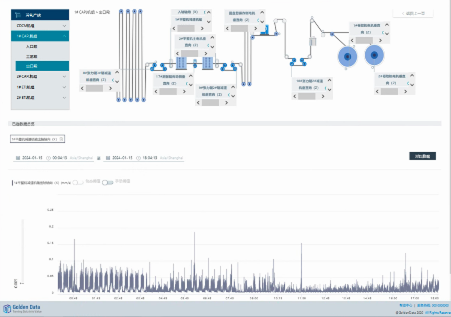
Vibration analysis
Vibration analysis is another key monitoring technique that plays an integral role in predicting the health of rotating machinery. By analysing vibration signatures, the system detects imbalance, misalignment and bearing wear — enabling predictive maintenance that addresses potential issues before they escalate into costly breakdowns. Crucially, an abnormal temperature rise in a roller may indicate excessive friction or misalignment, conditions that are often confirmed by concurrent changes in vibration patterns. Neither signal tells the whole story alone; together they do.
One platform, two signals: how DPlus connects them
Golden Data's DPlus platform correlates these sensor signals intelligently. It integrates AI-powered analytics and embedded industrial logic into lean manufacturing process management, transforming monitoring into active optimisation rather than passive observation. In practice, DPlus collects high-frequency infrared and vibration data, contextualises it against the asset and its operating conditions through the OODT object model, analyses it for anomalies, and acts — raising an event or work order before a failure occurs. This is the same closed loop our reliability expert agent, Riley, runs across other rotating-equipment fleets.
Case study: a CDCM cold rolling line
On a CDCM (continuous cold rolling) line, combining infrared and vibration monitoring with DPlus produced a measurable result. This real-time feedback loop allowed the production team to push throughput boundaries while maintaining control — running at substantially higher line speed without compromising product quality, and extending equipment life.
The wider value is straightforward: fewer unplanned stoppages, longer component life, higher OEE, and a production team that can safely push the line harder because it can see problems forming in real time.
The takeaway for steel operators
Infrared and vibration analytics are not new on their own — the step change comes from correlating them on a platform that understands the asset and can turn a signal into an action. For cold rolling lines under throughput pressure, that combination is one of the fastest routes from "we have sensors" to "we prevent failures."