Key takeaways
- Synthetic-diamond output depended on manual, operator-by-operator tuning of cubic-press machines — inconsistent and hard to scale.
- Golden Data applied neural networks, genetic algorithms and Faster R-CNN vision to optimise parameters per run.
- A key discovery: temperature and pressure — not cooling water — drive crystal quality.
- By removing on-site adjustments, engineers can remotely manage ~500 machines with improved consistency.
In the precision-driven world of synthetic diamond production, every percentage of efficiency gained translates into measurable value. Yet for years the process depended on something stubbornly inconsistent: the judgement of individual operators adjusting cubic-press machines by hand. The result was variability that was difficult to explain and harder to scale.
From manual judgement to AI-powered precision
Golden Data set out to replace intuition with data. Using neural networks, genetic algorithms and Faster R-CNN visual detection, the system learns the relationship between process parameters and outcomes, then tunes each production run accordingly. The algorithm dynamically adapts to each run, ensuring graphite columns achieve their optimal shape rather than relying on a fixed recipe.
Proof of concept: a small test, a big insight
A focused proof of concept produced the project's most valuable result — and it was counter-intuitive. Contrary to previous assumptions, temperature and pressure were the primary drivers of crystal quality, while cooling water mattered far less than operators believed. That single insight reframed how the whole process should be controlled.
Full-scale implementation: automation at scale
Once validated, the approach moved from a handful of presses to fleet scale. Because it eliminates the need for on-site adjustments, engineers can now remotely manage significantly higher machine numbers — the deployment spans roughly 500 cubic-press machines, with more consistent output and far less manual overhead.
The platform that powers it: DPlus
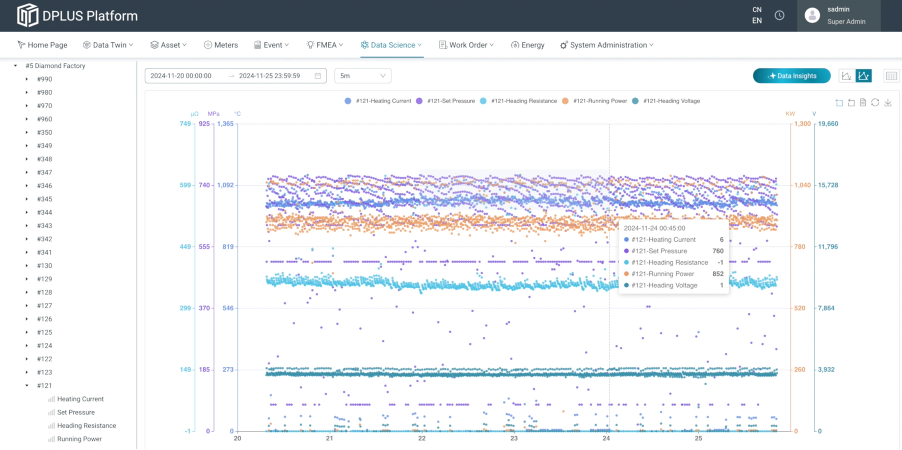
Underneath sits the DPlus platform, which collects production data, runs the optimisation algorithms and turns operator-dependent tuning into repeatable, data-driven control. The same capability is what our data-science expert agent, Oscar, brings to other non-standard, hard-to-model processes.
The takeaway
The lesson generalises well beyond diamonds: when a process depends on expert intuition, the fastest way to scale it is to find which variables actually matter — and let an algorithm hold them steady on every machine, every run.